
being interlinked
human hyper-connectivity in the digital age

Being interlinked— connecting, sharing, knowing. Such is the natural state of being a human among other humans.
As Blade Runner puts it (derived from the third canto of Vladimir Nabokov’s poetic novel Pale Fire), we exist within a system of cells interlinked. Our webs of connection are intricate, yet finite; they are where we derive our purpose and cement our worth. Each person holds value as a consequential participant in our system of socialization. We are important because we affect others. We connect with them, and have a biologically rooted desire to do so. What could be more meaningful— more human— than loving and being loved, knowing and being known, understanding and being understood?
To be closely interlinked with another person is one of our ultimate human aims. Our most sacred relationships compel us to share ourselves with honesty and vulnerability— a risk which pays off in the fulfillment of our yearning for genuine connection. They allow us to experience reciprocal trust, familiarity, unspoken cohesion, and unconditional belonging. These relationships are expansive and affirming, letting us be fully known, loved, and valued as our authentic selves. Our most special bonds transcend explanation; they are ineffably harmonic and distinctive.
Amid each of the relationship matrices which make up our social system, there are dimensions: of importance, of depth, of affectivity. Of course, not all our relationships reach an ultimately gratifying level of authenticity and trust. The precious and profound interlinked-ness I described above is most often found with people we would label as partners, best friends, or soulmates; we do not happen upon it often. Most of our relationships (apart from family members), then, would be categorized as friends, coworkers, and acquaintances. These types of connections are valuable, too, although not quite as deep; they bring us a sense of community, acceptance, and shared identity. They are people we know, and who know us.
The biological drive to connect has always been humanity’s central motive for pursuing and forming relationships. However, it is only in the last 20 years or so that the medium for this socialization has shifted, with the introduction of (here we go again…you knew it was coming!) the Internet. What could be more ideal for us communion-seeking humans, us creatures of connection, than a system of ubiquitous digital spaces which expands our social spheres to sizes never before possible throughout the entirety of human existence?
Surely— this is the key to the actualization of our deepest wishes for belonging!
BUZZER NOISE!! If only.
The intention of social media is implicit in its name: it is a medium (a location, completely removed from real, concrete life) through which we can socialize (interact with others). In theory, digital systems of socialization seem to increase our probability of forging deep connections; they give us more opportunities to get to know people, and thus form relationships. Our interconnectedness is increasing on the quantitative level: we can broadcast information about ourselves to an unprecedentedly numerous audience of people online through photos, videos, and text posts. Interpersonal interactions— conversations, meetings, divulgences of stories and experiences, windows into our daily lives— are becoming democratized. The speed and breadth of social media-driven exchanges is not possible without technological intervention. That is: it’s inhuman.
Our relational bonds are built through repeated exchanges— we share ourselves with other people, and they share ourselves with us. In ages past (i.e. all of human history before social media was introduced), bond formation necessitated face-to-face interaction in the form of engaged, active conversation. It occurred exclusively in the immediate presence of others, and was typically limited to small groups, if not pairs. Our number of relationships, then, was determined by the number of people we were capable of routinely, directly interacting with. These exchanges require time and intention; they are where authentic and reciprocal knowing is bred1. Without computers facilitating our social exchanges, we have to put a lot more effort into sharing ourselves with others. This work, though— intentional, direct interaction with another human— is key to forging the intimate interlinkage we so intrinsically crave.
Social media’s infiltration of our relationship systems has made us undoubtedly more interlinked— just not in the way we truly desire to be. It links us with more people by the numbers, but undermines our efforts and desires to attain true connection. Paradoxically, it is causing us to become hyperbolically disconnected from the physical world, our most important relationships, and our own selves.
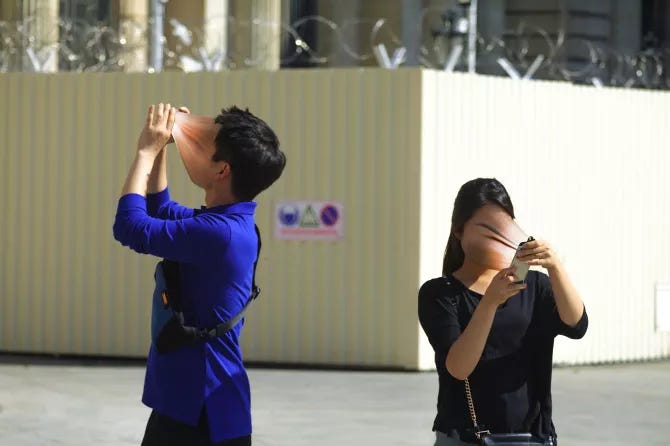
Our online followers can “get to know” us through a digital profile; they don’t need to talk to us at all. Social media extends the power of our finite social batteries by making interaction an effortless and widespread act. We can share information which was historically conveyed through direct conversation in a simple Instagram post or a tweet;2 no longer is this personal information reserved for those we are truly close to. We needn’t be picky about which people we share with, because we no longer have to expend time nor energy doing so. It’s incredibly easy— mindless, even— to post about a concert we went to, a shower thought we had, or a nice little vacation we took. We don’t need to tell someone about it; they can access evidence of our experiences online (see: unspoken, detached, and without selectivity). The sharing formerly done through attentive verbalized dialogues can now be distilled into story views, likes, and comments.
Our information, our personalities, are publicized; consequently, they are crushed down into a two-dimensional digital plane. They lose exclusivity, and thus value— they are available to all our mutuals, rather than being limited to those we are actively seeking to bond with. This collectivized consciousness3 of “knowing” on the internet intrudes upon the solitude of the self.
The “mutual” is a new type of relationship which has risen concomitantly with social media. Mutuals are people who we follow, and who follow us back. We might go to the same school as them, or they may be the friend of a friend. Sometimes, they are people we’ve never heard of, but who we deem acceptable followers because they share our interests or come from a background we are familiar with. Crucially: we know of them, but we do not know them.
An image of what we assume any mutual’s life is like can be easily conjured through an evaluation of their social media presence. We can approximate their likes and dislikes, where they’re from, what activities they enjoy, and who their good friends are. One can “get to know” a mutual through limited and indirect internet interaction; that is, by scrolling through someone’s online profile and viewing their posts, it is possible to hypothesize what they are like in real life. This alleged “knowing” of mutuals is incredibly superficial; the content a person displays on the internet is not an authentic portrayal of their true essence.
We are discriminate about what we post online. We share only the thoughts, photos, and messages which we believe will make the best impression on our followers (potential connections! right?). Of course, our motive to form relational bonds remains. In order to connect, we venture to portray ourselves as likable and interesting; our social media profiles are advertisements, and we are subjects of a pervasive viewership. Our online presences should feign authenticity and spontaneity to make ourselves appear more relatable. They are curated to seem intimate and real, yet are utterly cursory; the “secrets” we choose to share mustn’t tarnish our reputations by painting us as undesirable.
Online personalities, then, are fabricated amalgamations of our most alluring aspects. Any parts of us which may make us seem unsavory are evaded. We can be esoteric in a way which is alluring and mysterious, but certainly not in a way which comes off as overly bizarre. We should select photos which make us look beautiful, but not so much that we seem self-absorbed. We must share only what is picture-perfect: fit for perception by others. Displaying oneself online is a mendacious performance; while idealizing our personas in pursuit of communal acceptance and belonging, we denigrate and misrepresent the wholeness of our real selves.
Photographic internet content is especially impersonal and detached from genuine experience; it conveys an incredibly shallow picture (literally) of who we are. Photos turn us, subjects, into contextless objects. Each photo of us online is a singular, frigid excerpt of a very complex and vast experience. For the photo-taker, the subject, seeing an image elicits a memory of a time, a place, a sound, a feeling. For a removed beholder, a photo means only what one can assume based on visual details. Observing someone’s posts on Instagram is no way to know them— we cannot pick up on any details apart from what we see. The subject of the photo is objectified. Thoughts, feelings, memories, sensations— the intricacies of our humanity— are lost.
“Connecting” with others online is both effortless and incredibly effortful. It is laborious to select which pieces of our personalities to share, but we are free from any of the intentional work of making ourselves known once the “post” button has been pressed. We are observed and assessed, glamorized shells of personalities conveyed to mostly anonymous masses.
This sudden proliferation of online interlinkage has made it so the act of self-sharing is no longer reserved for the people we are actually close to; we are sharing ourselves with others at a preternatural speed and scope. Our barriers of relational proximity and privacy have been dilapidated by the pervasive demand to be in constant “connection” with our followers. Information about us is (if we desire it to be, of course4) displayed for a network of mutuals with whom we have not established any real knowing, let alone trust. We, as human individuals, have never been so readily accessible to the public eye, nor has our finitude been so grotesquely stretched.
Online relationships (with mutuals, especially) are trivial superficialities— hollow, transient wisps of the connection we innately desire. Through social media, we ostensibly connect with far more people, yet at a level which becomes ever shallower as our relational systems grow in size. Social media begs us to market ourselves, both undermining our senses of self and causing fabricated myths of our identities to circulate among the minds of our followers. The online self is merely a warped fragment of the human who created it.
Amidst this perpetual construction of an online persona (still, with the motive of connection in mind), we are utterly disengaged from our immediate lives. Each experience is evaluated as a potential piece of our digital profile: Can I post this on my Instagram? Will people like me better if they know I vacationed in Paris? Which of these hundreds of photos makes me look the best? Out of an obligation to share with our online followers, we remove ourselves from complete presence in the real world— physically, in the form of shifting our attention to a camera or phone, but also mentally and emotionally. We cannot relish in the singularity and sacredness of our experiences if we are preoccupied by the role they might play in bettering our digital presences; their secrecy is lost to the collective eye.
As our systems of interlinkage become more widespread, we are sacrificing the speciality of the immediate, the candid, the imperfect. We are forgetting what being truly interlinked actually means, and attempting to connect through a medium which is counterintuitive to our goal. Social media subverts genuine, effortful bonding, replacing it with fallacious impressions of distant others and a ceaseless fabrication of the self.
The self is no longer a privately owned entity in the digital age. It becomes inextricable from an exceedingly invasive and inorganic system of “connections,” which insidiously convinces us that the construction of a superficial, romanticized Internet Self will satisfy our primitive desire to be interlinked. In fact, internet interactions are undermining our capacity for true, deep connection— they are stealing us from the intimacy which breeds the truly sacred, supportive, loving relationships we crave and require to thrive.
To be interlinked— to know, to love, to see, to understand, to belong, to trust— is to engage in reciprocal, intentional sharing of the self. In contrast to the transient rapidity and superficiality of social media, connection requires time and presence. Slowing down, returning attentively to the present, and detaching from a deceitful facade: these acts reconnect us with our most authentic system of interlinkage, and make space for the sacred connections which help us to flourish.
Let's move on to system. System.
Feel that in your body. The system. What does it feel like to be part of the system? System.
Is there anything in your body that wants to resist the system? System.
Do you get pleasure out of being a part of the system? System.
Have they created you to be a part of the system? System.
Is there security in being a part of the system? System.
Is there a sound that comes with the system? System.
We're going to go on. Cells.
They were all put together at a time. Cells.
Millions and billions of them. Cells.
Were you ever arrested? Cells.
Did you spend much time in the cell? Cells.
Have you ever been in an institution? Cells.
Do they keep you in a cell? Cells.
When you're not performing your duties do they keep you in a little box? Cells.
Interlinked. Interlinked.
What's it like to hold the hand of someone you love? Interlinked.
Do they teach you how to feel finger to finger? Interlinked.
Do you long for having your heart interlinked? Interlinked.
Do you dream about being interlinked?
Have they left a place for you where you can dream? Interlinked.
What's it like to hold your child in your arms? Interlinked.
What's it like to play with your dog? Interlinked.
Do you feel that there's a part of you that's missing? Interlinked.
Do you like to connect to things? Interlinked.
What happens when that linkage is broken? Interlinked.
Have they let you feel heartbreak? Interlinked.
Did you buy a present for the person you love? Within cells interlinked.
Why don't you say that three times?
Within cells interlinked. Within cells interlinked. Within cells interlinked.
Blade Runner 2049
It goes without saying that these deep bonds still exist today— and are so much more special than our fleeting, superficial “connections” online! face-to-face connection is by no means dead— it’s just being overridden by the rise of very cursory social media interactions which really do nothing to help us bond with another. these bonds are performative and are misaligned with our desire to really, truly, deeply connect with others! authenticity seems to be a dying cause as we continue to characterize, glamorize, and market ourselves as digital citizens.
Sorry I will not be referring to Twitter or any of its related activities by their new name! (or would it be their new letter? new unicode character? never mind.)
I just finished The Candy House by Jennifer Egan… are you sensing some thematic overlap?
but do we really have a choice?
another banger of a piece!! (is it appropriate to call a beautiful literary work a "banger"???) i definitely struggle with trying to present myself in a way that respects my boundaries with the world, and for a long time, i thought the solution was to completely cut myself off from the internet and become this faceless, nameless thing that only consumed content. i realized i still resented this, which is why i love writing on substack because it isn't attached to the same kind of pressure to be picture-perfect that i've found on Instagram & TikTok...there is something so freeing about writing to a very small audience (for a time, i was scared to tell my friends ab it and was writing to literally no one) but knowing that i can at least be a little more genuine than i could to a a crowd of like....three hundred random people that i vaguely know and who i desperately hope think that i'm cool and funny. rambling aside, i really love how well-written this is -- especially the point you make about how attention is so heavily digitized in the forms of likes, comments, etc. so we can literally track how much time people are willing to devote to learning about our life. i hate the cheapening of our lives, the way we feel we need to exploit ourselves for a modicum of notice. so excited to read more from you and i hope you have a lovely day!!! <33